Asfalis Advisors

Case Study

Strengthening the System: How CLT Is Preparing Emergency Management for the Next Decade

With passenger volume and operational demands rising, Charlotte Douglas International Airport engaged Asfalis Advisors to conduct a comprehensive S.A.V.E. Assessment™ (Strengthen, Advise, Validate, and Educate) and Benchmarking Engagement, aligning its Emergency Management function with growing infrastructure, stakeholder needs, and long-term planning.

Executive Summary:

Charlotte Douglas International Airport (CLT) is one of the top 10 busiest airports in the United States, serving more than 58 million passengers and managing 590,000+ flights annually. Its rapid growth has added complexity and raised expectations for how Emergency Management supports daily operations and long-term resilience.

At CLT’s scale, each hour of downtime is estimated to cost $350,000+, making resilience an operational and financial priority.

CLT engaged Asfalis Advisors to conduct a S.A.V.E. Assessment™ and peer benchmarking project to address these risks. The engagement identified staffing and coordination opportunities and produced a Strategic Roadmap through 2033.

Outcomes included adopting CLT’s first EM Strategic Plan, expanded staffing, strengthening engagement for the Airport Incident Management (AIM) Working Group with clarified roles, and planning for a future Joint Operations Center.

Overview: Why CLT Reviewed Its Emergency Management Program

The Emergency Management team at CLT already had a solid foundation, effectively managing preparedness and response across a complex environment. However, leadership recognized that rapid expansion required more than operational capability. They needed clearer roles, stronger coordination, and a long-term plan aligned with the airport’s growth trajectory.

So, they partnered with Asfalis Advisors to lead that review. The goal was to understand what was working, identify gaps, and create a plan to support CLT’s continued growth through 2033.

The Challenge: Priorities Identified Through the Process

The assessment by Asfalis Advisors confirmed that CLT’s Emergency Management program had a solid base but revealed areas where structure and alignment needed to keep pace with the airport’s scale.

  • Role clarity across teams
    Conversations with staff and partners showed a strong commitment to EM, but ownership lines blurred during some incidents. In practice, teams sometimes improvised instead of following a clear path. This sometimes resulted in communication challenges, leaving opportunities to define responsibilities more sharply.
  • Strengthening existing tools
    Although the AIM Working Group was in place, opportunities for greater engagement and alignment surfaced. Stakeholders described it as more of an information-sharing forum. The opportunity was to re-establish clearer goals and operational guidelines, ensure consistent participation, and implement measurable follow-through so that AIM could strengthen its function as a coordination hub.
  • Scaling with growth
    Passenger volume and operational complexity had expanded faster than staffing and EM infrastructure. Without broader personnel depth and a consistent training rhythm, the EM program risked losing necessary resources to better support airport operations and unplanned disruptions.
  • Long-term alignment with growth
    Emergency Management was not always embedded in infrastructure planning or tied to enterprise-level metrics. Quantifying practical issues, such as acoustics in the Airport Emergency Operations Center and backup sites, underscored these risks and how they could impact the airport. An outcome leadership desired was for EM to be part of the airport’s capital planning and strategic planning processes to adjust how CLT embeds long-term resilience.

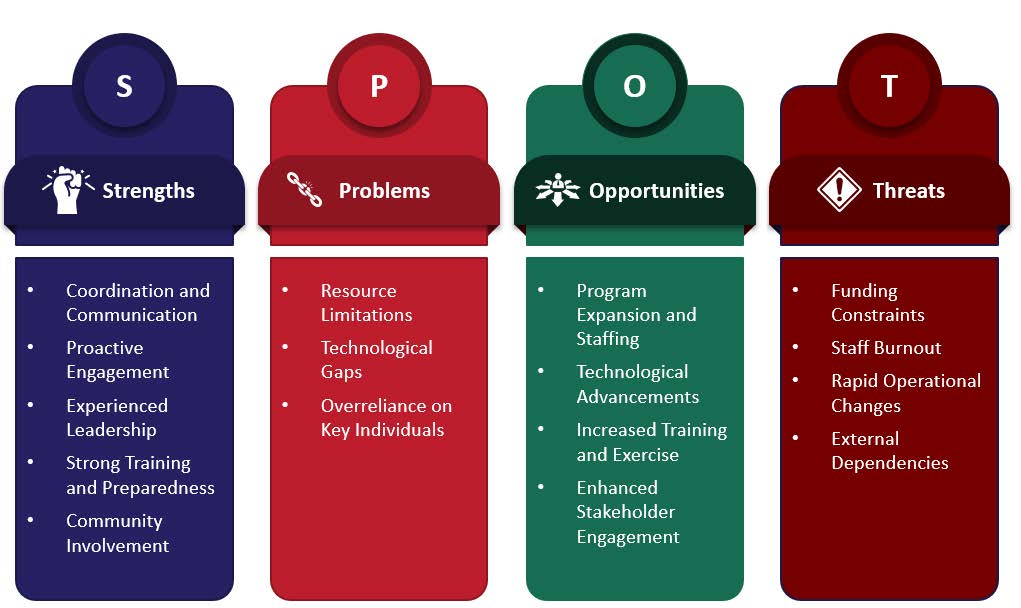
These findings provided CLT leadership with both focus and perspective, including clearer roles, a stronger use of existing tools, and a roadmap for scaling with growth. To ground those priorities in evidence, Asfalis Advisors created a SPOT analysis that captured the program’s strengths, problems, opportunities, and threats and showed precisely where the program stood and where to act next.

The SPOT analysis showed a strong base in collaboration and training, but resource gaps, reliance on key staff, and funding limits underscored the need for a long-term roadmap.

Goals: What the Engagement Was Designed to Achieve

The engagement with Asfalis Advisors aimed to move beyond assumptions and provide CLT with a clear, practical path to long-term sustainability while strengthening emergency management.

With that established, Asfalis Advisors focused on four core goals:

  1. Document current Emergency Management functions, roles, and capabilities.
  2. Benchmark CLT’s structure against airports of similar size and complexity.
  3. Clarify how internal departments and partner agencies coordinate before, during, and after incidents.
  4. Recommend models and a roadmap to guide program development through 2033.

Given that CLT already had a solid foundation. The key plan was to build on that with structure, clarity, and coordination that could keep pace with growth.

The Approach: How Asfalis Structured The Engagement

Step 1 – The S.A.V.E. Assessment™
To support the next phase of Emergency Management at CLT, Asfalis Advisors led a focused evaluation using its S.A.V.E. Assessment™. This proprietary process measures the maturity of emergency management, business continuity, and crisis programs in real time, pinpoints gaps, and provides actionable strategies to strengthen resilience.

The assessment reviewed seven key areas: (1) program management, (2) planning, (3) implementation, (4) execution, (5) training and education, (6) exercises and tests, and (7) program sustainment. It examined how well existing components worked, how prepared teams were, and what gaps might impact long-term coordination and resilience.

Step 2 – Benchmarking with Peer Airports
To contextualise CLT’s efforts, Asfalis compared the program with five peer airports: Hartsfield-Jackson Atlanta International Airport (ATL), Denver International Airport (DEN), Harry Reid International Airport (LAS), Orlando International Airport (MCO), and Raleigh-Durham International Airport (RDU). The data showed striking results. CLT’s program was aligned in many ways, but airports of similar size consistently staffed larger EM teams and ran 20 to 25 exercises annually.

The benchmarking also gave CLT’s leadership an idea of where the EM program stands today and what it will take to mature.

Step 3 – Internal and External Stakeholder consultation
Asfalis also spoke with internal departments and key external partners, including Charlotte Fire, Transportation Security Administration (TSA), Customs and Border Protection (CBP), and airline stakeholders. These discussions highlighted ways to improve coordination and consistency and opportunities to enhance the structure to better support existing resources, such as the AIM Working Group.

Based on these findings, Asfalis outlined three staffing and organisational models. These models helped shape the roadmap that followed and were organised into three phases:

Short-term (0 to 6 months):
  • Define performance metrics.
  • Clarify role ownership.
  • Resolve acoustic challenges in the AEOC.
Mid-term (6 to 18 months):
  • Relaunch the AIM Working Group.
  • Fill key roles in Emergency Management.
  • Start formal planning for a Joint Operations Center.
Long-term (18 months to 5 years):
  • Grow the Emergency Management team.
  • Establish a regular training cycle.
  • Implement Joint Operations Centre planning.

Each phase built on what was already working. The focus was on equipping staff, tightening coordination across teams, and creating a structure that could support and sustain CLT.

ROI That Spoke to Leadership

Executives don’t just want to know what to do; they want to see why it matters. For CLT, the financial business case was as strong as the operational one.

The math was simple. At this scale, downtime was valued at about $353K per hour. A four-hour disruption puts $1.4 million at risk. The 2017 Atlanta power outage, which cancelled over 1,400 flights and cost airlines $25M–50M in just 11 hours, demonstrated how quickly losses can compound. Independent research from the National Institute of Building Sciences reinforces the same point: every $1 invested in hazard mitigation saves $6.

Those numbers gave CLT leadership evidence to validate why investment in Emergency Management is a value protector. The conversation changes when you can demonstrate to your board, partners, or finance team that a modest increase in staff or training can prevent or reduce multimillion-dollar exposures. Emergency Management stops being a back-office function and becomes a strategic safeguard for the airport’s reputation and bottom line.

Results: Highlights from the Engagement

Following the engagement, Charlotte Douglas International Airport began taking early actions aligned with the Emergency Management roadmap co-developed by Asfalis Advisors. These steps focused on clarifying expectations, improving coordination, and reinforcing the existing foundation while planning for long-term growth and development.

Structural outcomes

  • The Strategic Roadmap became a working reference point. Emergency Management used it to guide conversations about structure, coordination, and future needs.
  • CLT adopted its first Emergency Management Strategic Plan, giving leadership a formal document to anchor decisions.
  • The AIM Working Group emerged more effective due to more substantial partner alignment, defined objectives, and consistent follow-through.
  • Planning continued for the Joint Operations Center (JOC), re-validating the need for a centralized, resilient facility and outlining next steps for development.
  • Staffing needs were identified, and headcount increased, reducing reliance on key individuals.
  • The roadmap served as the anchor for hiring and training, directly aligning resources with future growth.
  • Key performance indicators were defined so progress could be tracked in ways that leadership and partners could measure.

Cultural outcomes

  • Internal departments reported more clarity around roles and responsibilities, making coordinated responses smoother.
  • Leadership engagement strengthened with greater buy-in, visibility, and focus on other aspects of business resilience across enterprise risk management and business continuity.
  • Perhaps most importantly, Emergency Management has grown from 2 team members to 5+ team members as a proactive enabler of CLT’s growth.


Client voice

The client summed up the impact in the most straightforward way:

  • “The Final Report remains a staple for the Airport and has now become a strategic plan for us.”

  • “Tremendous value. To tell our story from an outside perspective is invaluable; when someone else can tell your story, it is huge. The programs grow as a result of the work Asfalis is doing, so the work is critical.”

  • Feedback from the broader team reinforced the partnership’s value, as evidenced by the 96% customer net promoter score (cNPS) rating.

What’s Ahead: Continuing the Work in Phase 2

In Phase 2, Asfalis continues to support CLT through an implementation period. This includes refining how teams work together, aligning strategic goals with long-term needs, evaluating program maturity, and advanced planning for the Joint Operations Center.

A follow-up S.A.V.E. Assessment™ will be conducted at the end of the Phase 2 period to measure progress and inform the next steps. The goal is to build a sustainable structure that fits the airport’s scale and supports daily operations.

As CLT grows, this work helps Emergency Management stay clear, consistent, and ready for what’s next.

Conclusion: What the Engagement Made Possible

The engagement gave CLT what every high-functioning team needs: a clear plan to scale what is already working.


The S.A.V.E. Assessment™ and benchmarking confirmed the team’s strengths while outlining specific, actionable ways to build structure and alignment for the future.

This shows what happens when structure meets momentum. CLT had a strong foundation. The engagement gave it direction. Now, emergency management is more aligned, more prepared, and better equipped to lead, no matter what comes next.

About Asfalis Advisors

Through our business resilience, emergency management, and business continuity expertise, Asfalis Advisors helps organizations prepare, respond, and recover from disruptions. We serve customers in transportation, tourism, sports, and entertainment to lead with clarity in high-pressure moments. Our team provides both strategic direction and implementation support so your programs work when it matters most.

Our Services

  • Crisis Management and Business Resilience Program Development
  • Business Continuity and Continuity of Operations Planning (COOP)
  • Emergency Management Program Development
  • A.V.E. Assessment™
  • Executive Advisory Services
  • Tabletop Exercises and Training
  • Threat and Hazard Risk Analysis
  • Emergency Management Strategic Planning

Ready to Strengthen Your Program?

Charlotte Douglas International Airport’s engagement with Asfalis demonstrates what becomes possible when structure supports instinct, and strong teams are equipped with the tools to grow.

If you lead a fast-moving organisation and want to strengthen your emergency management function, we are ready to help. Let’s discuss your goals and how to align your structure to achieve them.

Want to learn more about how Asfalis Advisors supports public sector growth and resilience?

Visit www.asfalisadvisors.com or contact us at [email protected] or

1-833-ADV-ISME (238-4763)